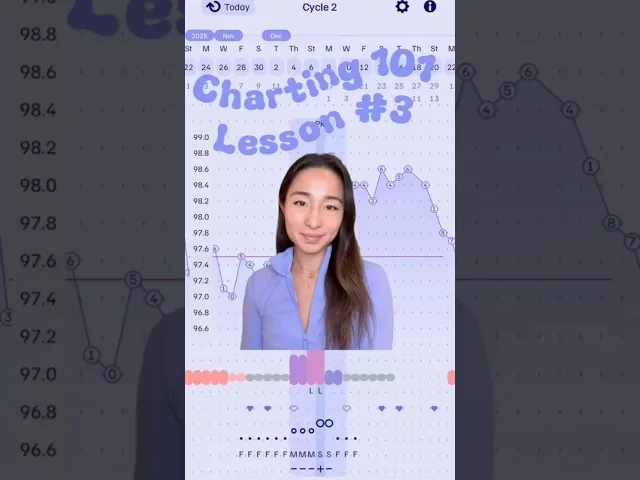

Charting 101 - Lesson #3: Cervical fluid
In this lesson on the Fertility Awareness Method we discuss the key way to know you are approaching ovulation: cervical fluid. As always, to learn more please read the book Taking Charge of Your Fertility.
If you would rather view this blog in video format, click here:
Cervical fluid is one of your body’s most powerful fertility signs. This is Charting 101, lesson #3.
Cervical fluid is the mucus your cervix produces, and it changes throughout your cycle in response to rising and falling estrogen. Interestingly, fertile cervical fluid contains glycoproteins that function like swim lanes and help the sperm quickly track towards the egg, otherwise they would just swim in all directions uselessly. Tracking your cervical fluid as it becomes more fertile helps you see your fertile window in real time—before ovulation happens. So unlike temperature which helps confirm ovulation occurred, cervical fluid lets you see that ovulation is approaching.
Here’s what to look for:
As your new cycle starts and your period ends, your cervical fluid should be Dry, indicating no fertility.
As your estrogen starts to increase, your cervical fluid will become Sticky. While this is also low fertility, it does signal the start of your potential fertile phase.
With your estrogen nearing its peak, your cervical fluid will become Creamy.
Eggwhite cervical fluid represents peak fertility, your body’s most fertile days.
After ovulation, your estrogen levels will fall rapidly and your cervical fluid should return to Dry.
Importantly, cervical fluid texture and consistency is different for every woman, so the descriptions of your own cervical fluid might not match up exactly with dry / sticky / creamy / eggwhite, but once you learn your pattern it should repeat itself each cycle.
By charting cervical fluid alongside your waking temperature, you get a full picture: cervical fluid signals the start of your fertile phase, and waking temperature confirms ovulation has happened and helps close your fertile phase, along with the return to dry cervical fluid. Together, they make the symptothermal method possible.
Follow along for more Charting 101. Next, we’ll talk about cervical position and why some women like to track it. And if you’re ready to start charting, download Cyclisity.
As a legal disclaimer, I want to add that this blog post is about the Fertility Awareness Method, not Cyclisity. Cyclisity is an app that helps women chart their cycles but is for informational and educational purposes only. It is not FDA approved as a medical device and does not provide any medical advice. Please consult your physician with any health questions you may have.