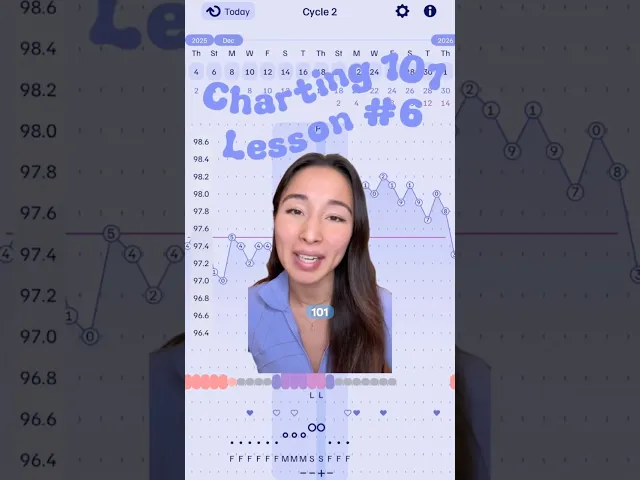

Charting 101 - Lesson #6: Coverline
In this lesson on the Fertility Awareness Method we discuss how to interpret your ovulatory temperature shift using the coverline concept. As always, to learn more please read the book Taking Charge of Your Fertility.
If you would rather view this blog in video format, click here:
It’s now time to learn what a coverline is. This is Charting 101, lesson #6. So what is a coverline?
The coverline, which on a chart is a horizontal line, is a method to separate the lower temperatures that occur pre-ovulation from the higher temperatures that occur post-ovulation. Remember, this temperature change is due to an increase in progesterone from the corpus luteum after ovulation.
You calculate the coverline each day by taking the last 6 temperatures and then making a line 1/10th of a degree Fahrenheit (or 0.05 degrees Celsius) above the highest temperature in that cluster. Technically the line should not be drawn in yet, but just remember it's there.
Now as you go along measuring temperatures and drawing imaginary coverlines, you have a temperature shift if the next temperature goes above the coverline. This temperature shift usually happens the day of or the day after ovulation, and is factored into the Peak Day Rule and Thermal Shift Rule when closing the fertile phase (don't worry we will cover those rules in a later blog post).
After you count 3 days of sustained high temperatures above the coverline, on the third day the egg is considered dead and gone by 6pm and the fertile phase can be considered ended at 6pm.
If this sounds a bit confusing to you, don’t worry, we will go over the peak day rule and thermal shift rule together in the coming lessons, and looking at a chart visually is also helpful for understanding.
Follow along for more Charting 101. Next, we’ll go over what a peak day is. And if you’re ready to start charting, download Cyclisity.
As a legal disclaimer, I want to add that this blog post is about the Fertility Awareness Method, not Cyclisity. Cyclisity is an app that helps women chart their cycles but is for informational and educational purposes only. It is not FDA approved as a medical device and does not provide any medical advice. Please consult your physician with any health questions you may have.